AI automation aesthetics clinic systems are the fastest way independent UK clinics can recover the revenue lost to no-shows, incomplete treatment courses and clients who book once and never return. The UK aesthetics market reached £3.6 billion in 2026, growing at 8 to 9 percent annually. Nevertheless, most of the 5,000-plus independent aesthetics clinics operating across the UK run on administrative systems that have not changed in years — a receptionist fielding calls, email reminders that go unread and a growing list of clients who started a laser course and quietly disappeared after session three. This guide covers every question an aesthetics clinic owner asks before committing to automation.
Why Aesthetics Clinics Lose More Revenue Than They Realise
What This Guide Covers — AI Automation Aesthetics Clinic 2026
- Independent aesthetics clinic owners and clinic managers exploring how AI automation aesthetics clinic tools could reduce no-shows and recover treatment course drop-off revenue
- Nurse prescribers, aesthetic doctors and solo practitioners running Botox, filler, laser and skin treatment clinics across UK, UAE, Australia and Canada
- Multi-treatment clinics offering laser hair removal, body contouring, microneedling or polynucleotide treatments where course completion directly determines revenue
- Aesthetics clinic owners spending more time on admin and re-booking than on delivering treatments
How AI Automation Aesthetics Clinic Systems Reduce No-Shows
No-shows are the single most avoidable source of revenue loss in an aesthetics clinic. Industry data consistently puts the average no-show rate between 15 and 30 percent without a structured reminder system. At an average treatment value of £200 to £500, two or three no-shows per week amounts to £1,600 to £6,000 in lost monthly revenue. Moreover, an open slot in an aesthetics clinic cannot be filled on short notice — that revenue is permanently lost.
The 4-Touchpoint Reminder Sequence That Cuts No-Shows by 43%
Research published in 2026 from a six-provider aesthetics practice found that a four-touchpoint automated reminder sequence reduced no-show rates from 14 percent to 8 percent — a 43 percent reduction. Furthermore, the automated waitlist system backfilled 65 percent of remaining open slots. Consequently, daily revenue exposure from empty slots dropped from £2,560 average to approximately £512 — a recovery of over £2,000 per day.
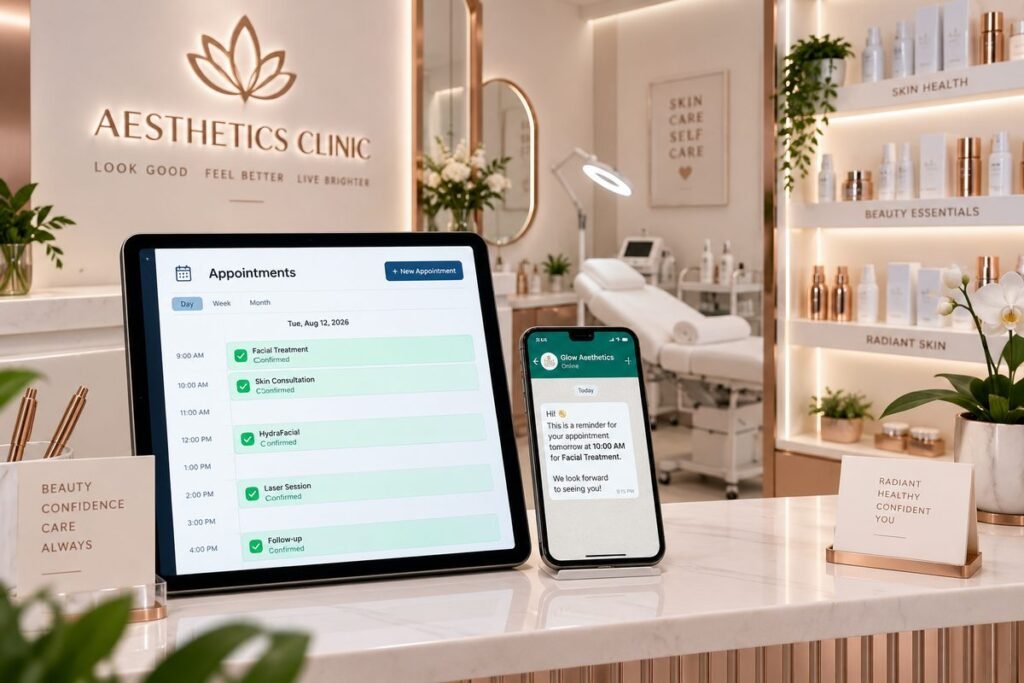
The sequence works as follows. Immediately after booking, a WhatsApp confirmation is sent with treatment details and pre-treatment preparation instructions. At 72 hours before the appointment, a reminder fires with a one-tap confirm or reschedule button. At 24 hours, a second reminder sends. On the morning of the appointment, a final nudge goes out. Clients who reschedule rather than no-show keep the revenue on the calendar — simply moved to a date that suits them.
Recovering Treatment Course Drop-Offs — The Biggest Revenue Gap in Aesthetics
Incomplete treatment courses are the signature revenue leak of the aesthetics industry — and one of the least discussed. Consider a clinic running 50 active laser hair removal courses simultaneously, each at £640 for 8 sessions. A 40 percent course drop-off rate represents £12,800 in lost revenue from incomplete courses alone every single month. Clients do not drop off because they are unhappy — they drop off because no one reminded them to book their next session.
How Automated Course Completion Works
We build treatment course tracking workflows that monitor each client’s progress through their treatment programme. Specifically, when a client completes session three of eight, n8n automatically calculates the optimal window for session four based on the treatment type — typically four to six weeks for laser, three to four weeks for skin treatments. At the right moment, a WhatsApp message fires reminding the client their next session is due and offering two available slots.
Furthermore, if the client does not respond within 48 hours, an AI calling agent reaches out by phone. The agent references the client by name, mentions the session they completed and explains why staying on schedule matters for their results. This approach is significantly more effective than a generic rebooking reminder because it is contextual — the client knows their own treatment is at stake. Consequently, course completion rates improve dramatically and the revenue that was quietly evaporating each month is recovered.
Handling New Client Enquiries After Hours — AI Automation Aesthetics Clinic Website
The UK aesthetics market is heavily driven by social media — TikTok alone has accumulated 21 billion views for #botox content. Consequently, new client enquiries arrive at all hours, particularly evenings and weekends when clinics are closed. A prospective client who researches laser hair removal at 10pm and finds a clinic that answers their questions immediately converts at a significantly higher rate than one who is told to call back during business hours.
Client Re-Engagement and Lapsed Client Recovery
Most aesthetics clinics have a substantial number of clients who attended once or twice and then stopped — not because they were unhappy, but because no one followed up. Botox clients typically need top-ups every three to four months. Filler clients return every six to twelve months. Skin treatment clients benefit from seasonal courses. Therefore, an automated re-engagement sequence that reaches out at the right interval recovers a significant proportion of lapsed clients at very low cost.
Automated Re-Engagement by Treatment Type
We build re-engagement workflows tailored to each treatment type. Botox clients who have not rebooked within ten weeks receive a WhatsApp message noting their treatment may be wearing off and offering to book a top-up. Filler clients receive a six-month re-engagement message. Laser course clients who dropped off receive a contextual message explaining the importance of completing their course for optimal results. Additionally, clients who have not visited in over six months receive a win-back campaign offering a seasonal treatment recommendation relevant to their history.
Research consistently shows that existing clients are between five and seven times cheaper to retain than acquiring new ones. Moreover, a client who returns for a Botox top-up often books additional treatments — a skin booster, a course of microneedling or a body contouring session. Consequently, re-engagement campaigns generate compounding revenue across multiple treatment categories.
How AI Automation Gets More Google Reviews for Aesthetics Clinics
Google reviews are the most important factor in local search visibility for aesthetics clinics. A clinic with 80 reviews averaging 4.8 stars consistently outranks a competitor with 20 reviews in local Google search results — regardless of which clinic has better clinical outcomes. Nevertheless, asking for reviews manually after every appointment is easy to forget and feels awkward in a clinical environment.
Automated Post-Treatment Review Requests
Automation removes both problems. Specifically, 24 hours after a client’s appointment is marked as completed, a WhatsApp message asks how they are getting on with their treatment. Clients who respond positively receive a direct link to your Google review page. This timing is deliberate — results from Botox and fillers are visible within 24 to 72 hours, so the client is at peak satisfaction when the review request arrives. Furthermore, for laser and skin treatment courses, the review request fires after the final session when the client has seen the full result of their investment.
Complete n8n Workflow Blueprint — AI Automation for Aesthetics Clinics
n8n is the automation layer connecting your booking system, WhatsApp communications, calling agent and follow-up sequences. You can read more about how n8n compares to other automation platforms in our guide on n8n vs Zapier vs Make 2026.
Full Cost Breakdown — AI Automation Aesthetics Clinic 2026
The monthly running cost of a complete AI automation aesthetics clinic system is typically recovered from a single prevented no-show per week. For most aesthetics clinics, the system pays for itself within the first two to three days of operation.
Monthly Running Costs — Independent Aesthetics Clinic
Estimated ROI — What the Numbers Look Like
These figures are illustrative and based on results we have seen across aesthetics and healthcare clients. Your specific numbers will depend on your treatment mix, appointment volume, average treatment value and current no-show rate. We model the numbers for your clinic specifically during a free strategy call.
Implementation Guide — AI Automation for Aesthetics Clinics Step by Step
Most aesthetics clinics have the core AI automation aesthetics clinic systems fully live within 2 weeks. Here is the realistic implementation path.
- Review your booking system — Fresha, Phorest, Cliniko, Jane App or other
- Map your treatment menu and course structures — sessions per course, optimal intervals
- Configure WhatsApp Business API and connect to n8n
- Build treatment-specific reminder messages — preparation instructions per treatment type
- Set up course tracking workflow — session completion triggers and next-session window calculations
- Configure Retell AI with clinic treatment menu, pricing, practitioners and clinical guardrails
- Build treatment course re-booking call scripts — personalised by treatment and session number
- Deploy Tidio chatbot on clinic website with treatment FAQ and booking intake
- Build re-engagement sequences by treatment type — Botox 10-week, filler 6-month, laser course drop-off
- Run end-to-end test — new booking through to course completion and review request
- Test all clinical guardrails — confirm AI does not make treatment suitability decisions
- Brief clinic team on what the system handles and what still requires practitioner input
- Run test re-engagement sequence for lapsed client scenario
- System goes live — monitor first week of reminder response and no-show rates
- Launch first lapsed client re-engagement campaign to clients who have not booked in 90 days
- Review Retell AI call recordings — refine course re-booking script based on real client conversations
- Review no-show data and course completion rates against pre-automation baseline at 30 days
Is AI Automation for Aesthetics Clinics CQC and GDPR Compliant
GDPR compliance for aesthetics clinic automation operates under standard UK GDPR. Patient contact data used for appointment reminders, course completion reminders and re-engagement campaigns falls under the legitimate interests legal basis — the same basis used for existing appointment reminder texts that clinics already send. For clinics that are CQC-registered — typically those performing PRP, dermal filler procedures under the new licensing regulations or other regulated treatments — the same governance principles apply as for other regulated healthcare settings.
What AI Does and Does Not Do in a Clinical Setting
The automation systems we deploy for aesthetics clinics handle appointment communication, booking intake and client re-engagement only. Specifically, they do not make clinical suitability determinations, treatment recommendations or medical advice. All clinical decisions — patch testing, contraindication screening, treatment suitability and aftercare advice — remain with the registered practitioner. Furthermore, the website chatbot includes explicit guardrails directing all clinical questions to a consultation with your practitioner.
The UK government’s aesthetics licensing consultation is ongoing in 2026. Scotland has already passed legislation increasing restrictions on non-surgical cosmetic procedures. All AI communication systems we deploy for aesthetics clinics are configured in line with current ASA advertising guidelines — AI agents do not make efficacy claims, before-and-after outcome promises or comparative statements about treatments. We review this configuration with every clinic before deployment. We strongly recommend seeking independent legal advice on your clinic’s specific regulatory obligations, particularly regarding advertising rules for Botox and prescription-only treatments.
How Long Before an Aesthetics Clinic Sees Results
No-show reduction shows measurable results within the first two weeks of deployment. After-hours enquiry capture shows results from day one. The first lapsed client re-engagement campaign — typically run in the first week after go-live — generates bookings within 48 hours for most clinics.
Our Honest Assessment — AI Automation for Aesthetics Clinics in 2026
The UK aesthetics market is growing faster than almost any other sector in healthcare. However, most independent clinics are competing on clinical skill alone while losing 15 to 30 percent of their booked revenue to no-shows every month and thousands more to treatment course drop-offs that automation would prevent. The ROI case for aesthetics clinic automation is among the clearest of any business type we work with. Start with appointment reminders — prove the no-show reduction — then expand to course tracking and re-engagement. A clinic that automates these three systems typically recovers more revenue in the first month than the annual cost of the entire automation stack.
Frequently Asked Questions — AI Automation for Aesthetics Clinics
No-Shows, Course Drop-Offs and Re-Engagement
Booking Systems, Compliance and Results
Costs and Results Timeline
Solo Practitioners and Results Timeline
Results Timeline
Book a free 30-minute call with our team. We will review your current no-show rate, treatment mix, course structures and booking system — and give you an honest view of what automation will achieve and what it will cost for your specific clinic.
Book Free Strategy Call →growth@aiotagen.com | WhatsApp: +92 347 672 3746
Aiotagen builds AI automation systems for aesthetics clinics, healthcare practices, real estate agencies, law firms and professional services businesses across UK, UAE, Canada, Australia and Pakistan. 48+ systems deployed. GDPR compliant configurations available. aiotagen.com