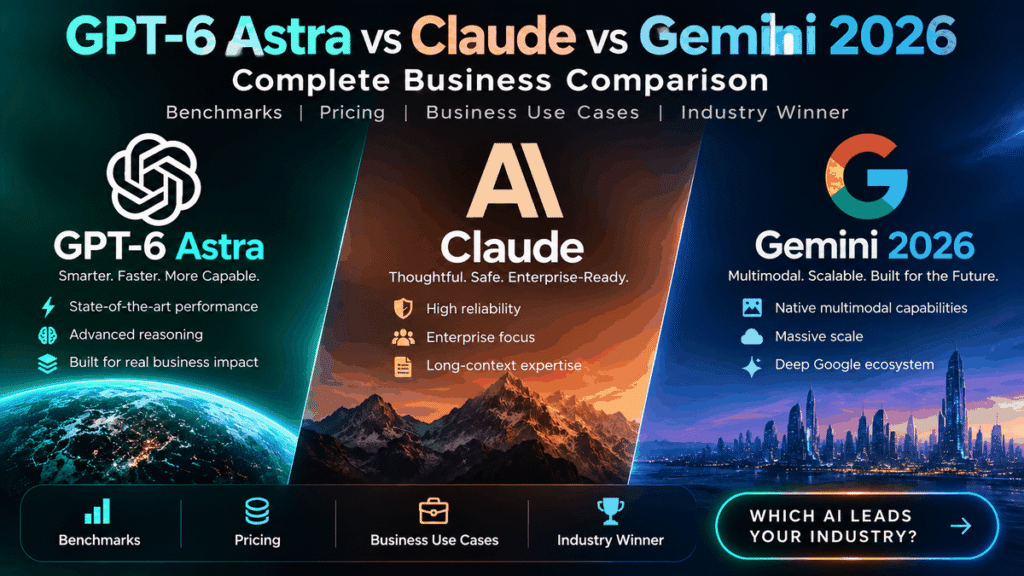
GPT-6 Astra vs Claude vs Gemini is consequently the most consequential AI comparison of 2026 — yet the answer is far more nuanced than any single headline suggests. Specifically, OpenAI launched GPT-6 Astra on September 3, 2026, calling it “the start of the AGI era.” Meanwhile, Anthropic had already released Claude Opus 5 in July, with Claude Fable 5.1 following on September 1. Furthermore, Google shipped Gemini 3.8 Flash on September 2 — meaning three frontier-class models arrived within 48 hours of each other. Consequently, for businesses deciding which model to build on, the differences in capability, pricing and best-fit use cases are enormous. Consequently, this guide covers every benchmark and pricing detail — and exactly which model wins for which business scenario in 2026.
The Week That Changed AI — Three Models in 48 Hours
The Three Models — GPT-6 Astra, Claude and Gemini
GPT-6 Astra — Full Deep Dive
GPT-6 Astra is the most ambitious OpenAI model release to date. OpenAI president Greg Brockman described it as “the start of the AGI era” — significant and precisely worded. Specifically, Astra does not claim to be AGI outright — however, it saturates benchmarks designed to stay ahead of AI capability. It scored 99.9 percent on ARC-AGI-3. For context, GPT-5.6 Sol scored 7.8 percent and Claude Opus 5 scored 30.2 percent. Furthermore, it scored 100 percent on ExploitBench. However, that cybersecurity result is gated exclusively to vetted organisations through OpenAI’s Daybreak program.
GPT-6 Astra — Technical Specifications
| Specification | Detail |
|---|---|
| Model ID | gpt-6-astra |
| Context Window | 1,050,000 tokens (1.05M) |
| Max Output | 128,000 tokens |
| Knowledge Cutoff | April 30, 2026 |
| Input Modalities | Text, Image |
| API Price (Input) | $10 per million tokens |
| API Price (Output) | $50 per million tokens |
| Available Via | OpenAI API, AWS Bedrock, Microsoft Foundry, ChatGPT Plus/Pro/Business/Enterprise |
| Training Scale | 100,000+ GPUs at Stargate Texas — largest training run in OpenAI history |
GPT-6 Astra — What Makes It Different
Notably, Astra’s defining advantage is computer use and agentic automation. Notably, it scored 92.7 percent on ScreenSpot-Pro — navigating desktop interfaces without tools. Specifically, GPT-5.6 Sol scored 76.9 percent and Claude Fable 5 scored 87.3 percent. Moreover, on OSWorld 2.0, Astra completed tasks at roughly 47 percent less time per task than its predecessor. Furthermore, Astra uses approximately one-fifth the tokens of Claude Opus 5 for equivalent coding-agent tasks. Consequently, its higher per-token price is partially offset by this efficiency.
Notably, the hallucination rate improvement is also significant — Artificial Analysis measured Astra at 51 percent at max effort, down from 92 percent for GPT-5.6 Sol. Consequently, Astra is significantly more reliable where factual accuracy under complex reasoning pressure matters. Furthermore, Brockman claimed users “won’t ever have to click a mouse or type on a keyboard again” — reflecting Astra’s computer-use architecture, specifically the first model where OpenAI is genuinely confident in autonomous multi-step desktop task completion.
Claude Opus 5 — Full Deep Dive
Claude Opus 5 launched July 24, 2026 — two months before Astra — and has consequently accumulated significant real-world production mileage that Astra simply does not have yet. Furthermore, Anthropic positioned it as “frontier at half the price” of its own top tier — now Claude Fable 5.1. As a result, Claude Opus 5 matches or exceeds Astra on several coding benchmarks at exactly half the input token cost.
Claude Opus 5 — Technical Specifications
| Specification | Detail |
|---|---|
| Model ID | claude-opus-5 |
| Context Window | 1,000,000 tokens (1M) |
| Max Output | 128,000 tokens |
| Arena ELO | 1,522 (Artificial Analysis September tracker) |
| Throughput | 74 tokens per second |
| API Price (Input) | $5 per million tokens |
| API Price (Output) | $25 per million tokens |
| SWE-bench Score | 96.0% — ranked #2 overall as of August 31, 2026 |
| Coding Agent Index | Leads Artificial Analysis index over Astra (Opus 5: ahead; Astra: 67) |
Claude Opus 5 — What Makes It Different
Claude Opus 5 is the strongest model for sustained coding and complex agentic runs. In these scenarios, reliability matters more than raw benchmark peaks. Specifically, it scored 96.0 percent on SWE-bench — the industry-standard real-world coding benchmark — which is a verified, independently-run score. Furthermore, Anthropic cut cache-read pricing 75 percent on September 1 — from $1.00 to $0.25 per million tokens. Consequently, cached workloads are now significantly cheaper. Consequently, for businesses running repeated similar tasks, the cached pricing model makes Opus 5 the cost-efficient choice.
Furthermore, the two-month production track record also matters for businesses. Notably, Astra’s benchmarks are fresh-from-launch numbers. Meanwhile, Claude Opus 5’s numbers are battle-tested across production deployments. Moreover, the Artificial Analysis Coding Agent Index puts Astra at 67 versus Fable 5.1 at 70. Consequently, Claude Opus 5 sits at competitive parity with Astra on that composite. Therefore, for the majority of real-world coding and agentic tasks, Claude Opus 5 at half Astra’s price is the rational production choice.
Gemini 3.8 Flash — Full Deep Dive
Gemini 3.8 Flash is the most underrated model in this comparison — and arguably the most important for businesses. It launched September 2, 2026 at exactly the same price as Gemini 3.7 Flash. Consequently, it is a free performance upgrade for existing users. Google describes it as “our most intelligent Flash model.” Furthermore, it is engineered specifically for long-horizon software engineering, autonomous agents and enterprise workflows. Specifically, at $0.75 per million input tokens versus Astra’s $10, it is 13 times cheaper. Notably, on several coding benchmarks it sits within one percentage point of Claude Opus 5.
Gemini 3.8 Flash — Technical Specifications
| Specification | Detail |
|---|---|
| Model ID | gemini-3.8-flash |
| Context Window | 1,048,576 tokens (1M) |
| Max Output | 65,536 tokens (64K) |
| Knowledge Cutoff | March 2026 |
| Input Modalities | Text, Image, Video, Audio, PDF |
| API Price (Input) | $0.75 per million tokens (until Dec 31, 2026) |
| API Price (Output) | $3.75 per million tokens |
| Price from Jan 2027 | $1.50 / $7.50 per million tokens |
| Thinking Levels | Low / Medium (default) / High — configurable |
| DeepSWE Score | 73.7% — within 0.4 points of Astra (74.1%) |
Gemini 3.8 Flash — What Makes It Different
Gemini 3.8 Flash’s advantage is multimodal capability at commodity pricing. Additionally, it accepts text, image, video, audio and PDF input. Notably, it is the only model in this comparison that natively handles video and audio. Consequently, for businesses dealing with video, meeting recordings and audio transcription, Gemini 3.8 Flash does more natively than either Astra or Opus 5. Furthermore, configurable thinking levels — low, medium and high — let cost-sensitive workflows dial down reasoning on simple tasks. Notably, the introductory pricing window closes December 31, 2026. Specifically, costs double then — so building on it now locks in significant cost advantages.
GPT-6 Astra vs Claude vs Gemini — Benchmark Comparison
Notably, the benchmark data tells a more nuanced story than any launch marketing suggests — specifically, independent benchmarks paint a different picture from OpenAI’s own launch table, which selected rows where Astra leads most prominently.
Head-to-Head Benchmark Table — September 2026
| Benchmark | GPT-6 Astra | Claude Opus 5 | Gemini 3.8 Flash | What It Measures |
|---|---|---|---|---|
| ARC-AGI-3 | 99.9% ★ | 30.2% | — | Abstract reasoning on unfamiliar tasks |
| FrontierMath Tier 4 | 97.6% ★ | 87.8% | — | Frontier-level mathematics |
| ExploitBench | 100% ★ | 70% | — | Cybersecurity exploit creation (gated) |
| SWE-bench Verified | ~74% | 96.0% ★ | ~74% | Real-world software engineering |
| DeepSWE v1.1 | 74.1% | 73.7% | 73.8% ≈ | Long-horizon coding tasks |
| Terminal-Bench 4.0 | 57.9% ★ | — | — | Multi-step terminal and tool use |
| Terminal-Bench 2.1 | — | ~74% | 89.4% ★ | Terminal engineering tasks |
| OSWorld 2.0 | 72.6% ★ | — | 59.0% | Real desktop navigation and task completion |
| ScreenSpot-Pro | 92.7% ★ | — | — | GUI element identification and navigation |
| AA Intelligence Index | 61.2 | — | — | Neutral third-party intelligence composite |
| AA Intelligence Index | — | Leading ★ | — | Claude Fable 5.1 leads at 65.7 vs Astra 61.2 |
| Arena ELO | — | 1,522 ★ | — | Human-preference voting across tasks |
| Hallucination Rate | 51% ★ | — | — | Lower = better (GPT-5.6 Sol was 92%) |
| FrontierCode 1.1 | 53.3% | 53.4% | — | Effectively tied (within margin of error) |
Note: ★ = Winner in that category. Furthermore, ≈ = Effectively tied. Importantly, Astra’s benchmarks were run September 3-5, 2026 — just days old. However, Claude Opus 5 benchmarks are two months of production-verified data. Consequently, treat vendor-reported scores with appropriate caution — independent verification is still catching up.
GPT-6 Astra vs Claude vs Gemini — Pricing in Practice
Furthermore, the pricing gap between these three models is the most practically important factor for businesses — specifically, it is a 13x difference between the most and least expensive option for the same input volume.
What Each Model Costs at Business Scale
Real Cost Example — Processing 1 Million Customer Service Messages
| Model | Input Cost (1M msgs × 500 tokens avg) | Output Cost (200 tokens avg) | Total Monthly |
|---|---|---|---|
| GPT-6 Astra | $5,000 | $10,000 | $15,000 |
| Claude Opus 5 | $2,500 | $5,000 | $7,500 |
| Gemini 3.8 Flash | $375 | $750 | $1,125 ★ |
Notably, for high-volume customer service or content generation at scale, Gemini 3.8 Flash is not just cheaper. Indeed, it is transformatively cheaper. Furthermore, the quality gap on conversational tasks and standard business writing is negligible between the three models. Consequently, most businesses running high-volume automated tasks should use Gemini 3.8 Flash. However, reserve Claude Opus 5 or Astra for complex, high-stakes tasks where the quality premium is genuinely justified.
GPT-6 Astra vs Claude vs Gemini — Business Use Case Winners
Which Model Wins for Which Business Task
GPT-6 Astra vs Claude vs Gemini — Customer-Facing Tasks
GPT-6 Astra vs Claude vs Gemini — Research and High-Value Tasks
GPT-6 Astra vs Claude vs Gemini — Automation Use Cases
Which Businesses Should Use Which Model
Industry-by-Industry Recommendation
GPT-6 Astra vs Claude vs Gemini — More Industry Recommendations
GPT-6 Astra vs Claude vs Gemini — Pricing Verdict
Furthermore, the pricing comparison is the clearest and most decisive factor for most businesses. Specifically, Astra costs 13 times more than Gemini 3.8 Flash on input tokens. Moreover, it costs 2 times more than Claude Opus 5. Consequently, the case for Astra is compelling only when its specific advantages — computer use, abstract reasoning or agentic automation — are genuinely required.
Our Verdict — Which Model Wins Overall
- Autonomous computer and desktop use
- Complex multi-step agentic workflows
- Frontier mathematics and science
- Cybersecurity (Daybreak program)
- Notably, high-value tasks where token efficiency offsets price
- Research organisations and enterprise AI teams
- Software engineering and code review
- Long-document analysis (legal, finance)
- Marketing copy and content strategy
- n8n workflow building and debugging
- Any task needing human-preferred writing quality
- Specifically, production deployments needing battle-tested reliability
- High-volume customer service automation
- WhatsApp chatbots and messaging
- Video, audio and PDF processing
- SME and startup AI automation (budget-conscious)
- E-commerce and retail communication
- Any task where cost per message matters
GPT-6 Astra vs Claude vs Gemini — The Honest Summary
GPT-6 Astra is genuinely impressive — however, it is not the right model for most business tasks most of the time. Specifically, its advantages are concentrated in computer use, abstract reasoning and cybersecurity — important to specific industries but not representative of most business AI usage. Furthermore, its per-token price makes running it at scale without a clear performance requirement simply wasteful.
Claude Opus 5 is consequently the production workhorse of 2026. Notably, it brings two months of battle-tested production data, leads on coding benchmarks and consistently produces the highest-quality written output — all at half the cost of Astra. Therefore, for most technology companies, agencies and professional services firms, Claude Opus 5 remains the default recommendation.
Furthermore, Gemini 3.8 Flash is, perhaps, the biggest surprise of the week. At 13 times cheaper than Astra, it is consequently the model that will power the majority of automated business workflows in Q4 2026. Furthermore, the performance gap on customer communication, content and document processing is negligible — and additionally, its native video and audio support gives it a unique capability that no other model in this comparison offers.
Therefore, the correct answer for most businesses is not one model — it is a routing strategy. Specifically, use Gemini 3.8 Flash for high-volume routine tasks. Meanwhile, Claude Opus 5 handles complex analytical work. However, reserve Astra only where its specific advantages justify the premium.
How Aiotagen Builds With These Models
At Aiotagen, we build AI automation systems for businesses across UK, UAE, USA, Canada, Pakistan and Australia. Consequently, model selection is based on specific task economics — not headline models. Our n8n workflows route intelligently across models based on task type and volume — automatically. Specifically, a high-volume WhatsApp chatbot uses Gemini 3.8 Flash. Meanwhile, a complex legal document analysis workflow uses Claude Opus 5. Furthermore, an autonomous computer use agent for a tech company uses GPT-6 Astra. Furthermore, as September 2026 demonstrated, model capabilities can shift dramatically within 48 hours. Consequently, our architecture allows model switching without rebuilding the underlying automation.
Frequently Asked Questions — GPT-6 Astra vs Claude vs Gemini
Model Access and Pricing
Business Use and Cost Decisions
GPT-6 Astra vs Claude vs Gemini — Future Outlook
GPT-6 Astra Pricing — Future Outlook
Claude Fable 5.1 — Where It Fits
Specifically, book a free 30-minute call with our team. Specifically, we design AI automation systems that route intelligently across GPT-6 Astra, Claude Opus 5 and Gemini 3.8 Flash. Consequently, each task gets the right model at the right cost.
Book Free Strategy Call →growth@aiotagen.com | WhatsApp: +92 347 672 3746
Notably, Aiotagen is an AI automation agency based in Islamabad, Pakistan. We build AI automation systems for businesses across UK, UAE, USA, Canada, Australia and Pakistan using GPT-6 Astra, Claude Opus 5, Gemini 3.8 Flash and n8n workflows. Furthermore, benchmark data sourced from DataCamp, MindStudio, Vellum, Artificial Analysis, ARC Prize and vendor documentation — September 2026. aiotagen.com