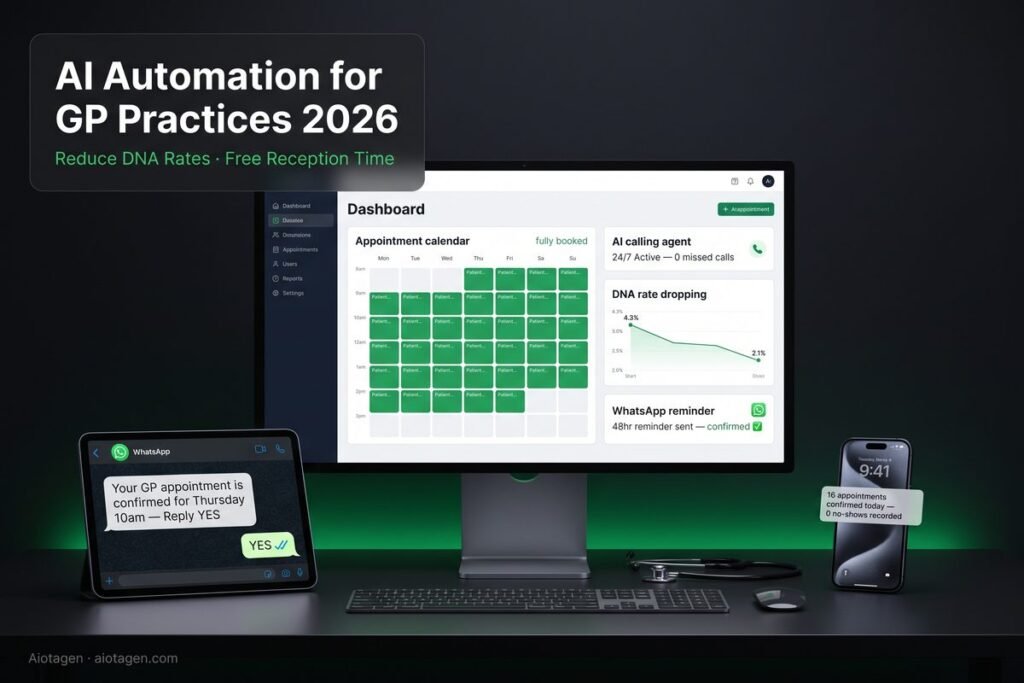
If your GP practice is losing patients to missed calls or watching your reception team spend hours on tasks that software could handle — AI automation for GP practices is worth a closer look in 2026. NHS England data shows that 16 million GP appointments were missed in 2025 — equivalent to 4.3% of all appointments, or roughly one entire day of missed appointments at every GP practice in England each month. Meanwhile, NHS England’s 2026 campaign found that 1 in 4 patients missed an appointment simply because they forgot. Automated reminders solve this directly. This guide covers what AI automation for GP practices can realistically do in 2026. We cover which tools are worth considering, what they cost and what the honest limitations are — including the NHS primary care data constraints.
Is AI Automation Right for Your GP Practice?
- GP practice managers exploring whether AI automation could reduce their administrative workload
- Practice partners considering tools to reduce DNA rates without adding reception headcount
- Private GP clinics and mixed NHS/private practices with more flexibility over their systems
- Primary care network managers evaluating automation options across multiple practices
Before You Read — A Note on NHS Data Governance
NHS primary care operates under specific data governance requirements including NHS DSPT (Data Security and Protection Toolkit), UK GDPR and CQC registration standards. Any AI automation tool handling patient data at an NHS GP practice must be evaluated against these requirements — not just general GDPR compliance. We strongly recommend involving your Data Protection Officer and seeking independent legal review before deploying any third-party automation tool that touches patient records or appointment data. The tools discussed in this guide are used primarily by private GP clinics and mixed practices. Their suitability for NHS data handling depends on your specific configuration and governance arrangements.
What AI Automation for GP Practices Can Actually Do
To begin with, it helps to be specific about what automation handles well and what it does not. Indeed, many practices have unrealistic expectations in both directions — either assuming AI will solve every staffing problem, or dismissing it entirely because it seems incompatible with NHS systems. The reality is more nuanced and more practical than either position.
What Automation Handles Well
- Appointment reminders: Sending WhatsApp or SMS reminders 48 hours and 2 hours before appointments — addressing the single most common reason for DNAs
- After-hours enquiry capture: Answering calls and web form submissions outside surgery hours, collecting patient details and routing urgency appropriately
- Repeat prescription request handling: Collecting prescription requests via WhatsApp or website chatbot and routing them to the clinical team
- Patient recall campaigns: Sending automated recall messages for flu jabs, smear tests, chronic disease reviews and other scheduled interventions
- New patient registration enquiries: Handling initial registration queries and collecting basic information before human review
- FAQ handling: Answering common questions about opening hours, parking, how to request a sick note, how to register — freeing reception time for clinical queries
Where AI Automation for GP Practices Has Clear Limits
- Clinical triage: AI systems should not make clinical triage decisions. Any system that routes patients based on symptom description requires careful clinical governance oversight
- Direct integration with EMIS or SystmOne: Most third-party automation tools do not have direct read/write access to NHS clinical systems. Data typically flows through manual steps or approved integration layers
- Replacing clinical judgment: Automation handles the administrative layer around appointments — not the clinical content of those appointments
- Complex multi-step patient journeys: Patients with complex needs or safeguarding concerns should always reach a trained human quickly and reliably
AI Automation GP Practice — Best Tools for Appointment Reminders
Notably, appointment reminders are the highest-impact, lowest-complexity automation available to GP practices. Specifically, they directly address the most common cause of DNAs and require no clinical system integration — they work from a separate appointments calendar or a simple patient contact list. Notably, this is where most practices start, and where the ROI case is clearest.
NHS-Compatible Alternative — Accurx for GP Practices
Best AI Calling Agent for GP Practice Automation
Moreover, an AI calling agent answers inbound patient calls outside surgery hours — taking messages, handling repeat prescription requests, answering FAQ queries and routing urgent calls appropriately. For private GP clinics and mixed practices, this is consequently one of the most impactful automation tools available. For NHS practices, the governance considerations are more significant and require careful evaluation.
AI Automation GP Practice — Emergency Call Handling
Any AI calling agent deployed at a GP practice must include robust emergency handling from day one. Specifically, we configure explicit routing rules for any caller describing potential medical emergencies — the agent immediately provides the 999 number and the local out-of-hours service number, and does not attempt to take a message or book an appointment. This is tested extensively before go-live. Additionally, we always include a clear option to speak with a human for patients who prefer it or who the agent cannot assist effectively.
Best Website Chatbot for AI Automation GP Practice Websites
Furthermore, a website chatbot handles patient queries on your practice website around the clock — answering questions about registration, opening hours, repeat prescriptions, referral processes and appointment availability — without requiring reception staff to respond individually to each enquiry.
Complete n8n Workflow Blueprint — AI Automation for GP Practices
Additionally, n8n is the automation layer connecting reminder systems, calling agents and communication tools without requiring direct clinical system integration. You can read more about how n8n compares to other automation tools in our guide on n8n vs Zapier vs Make 2026.
The 6-Step Workflow — How It All Connects
Implementation Guide — AI Automation for GP Practices Step by Step
Most practices can have the core automation systems live within 2 to 3 weeks. However, the timeline is slightly longer than for private practices because of additional governance steps. Here is the realistic implementation path.
- Review data governance requirements with your DPO first
- Confirm legal basis for automated patient communication
- Select tools based on your NHS or private practice status
- Get data processing agreements from all tool providers
- Update practice privacy notice to reflect new processing activities
- Connect WhatsApp Business API to n8n automation workflow
- Build appointment confirmation, 48-hour reminder and 2-hour reminder sequences
- Configure recall campaign templates for flu, smear and chronic disease reviews
- Test full reminder sequence with internal team before patient-facing launch
- Configure Retell AI with practice-specific after-hours script
- Build emergency routing logic — test with real emergency scenario simulations
- Deploy Tidio chatbot on practice website with FAQ configuration
- Run full end-to-end testing across all patient journey touchpoints
- Brief reception team on what the system handles and what still needs human input
- Review first two weeks of reminder response rates and DNA data
- Adjust reminder timing and message content based on patient response patterns
- Review calling agent call recordings and refine script for common patient queries
- Expand recall campaigns to additional patient groups as confidence builds
Full Cost Breakdown — AI Automation GP Practice Guide
Monthly Running Costs — Private GP Clinic or Mixed Practice
Estimated ROI — What the Numbers Look Like
These figures are illustrative. NHS practices do not directly recover revenue from reduced DNAs in the same way private clinics do — however, the operational benefit of freeing those slots for waiting list patients is real and measurable. We would be happy to model the numbers for your specific practice situation during a strategy call.
Honestly, AI automation delivers clearer and faster ROI for private GP clinics and mixed practices than for pure NHS practices — primarily because the data governance constraints in NHS primary care add complexity and because the revenue recovery mechanism is more direct in private practice. Nevertheless, NHS practices absolutely benefit from reduced DNA rates, freed reception time and better patient communication. Therefore, the starting point for any NHS practice should be appointment reminders and FAQ chatbots — not clinical AI or complex system integrations. Start simple, prove the value, then expand. Private practices have more flexibility and can typically move faster and further with automation tools.
Frequently Asked Questions
Is AI automation for GP practices GDPR compliant under UK law?
It depends on the specific tools, how they are configured and what data they handle. General GDPR compliance from a tool provider does not automatically satisfy NHS DSPT requirements for practices holding NHS patient data. Specifically, NHS practices must ensure any third-party tool handling patient data meets the NHS Data Security and Protection Toolkit standards. We recommend involving your DPO before deploying any automation tool and obtaining a Data Processing Agreement from every tool provider. Private practices operate under standard UK GDPR — still significant but more straightforward to manage with off-the-shelf tools.
Does AI Automation for GP Practices Work With EMIS or SystmOne?
Most third-party automation tools do not have direct read/write integration with EMIS or SystmOne — the two most common NHS clinical systems. Consequently, the automation systems we deploy typically work alongside these systems rather than within them: reminders are triggered from a separate appointments calendar or exported contact list, not directly from the clinical system. Accurx is the main exception — it has native EMIS and SystmOne integration and is widely used in NHS practices specifically for this reason.
What happens if a patient has a medical emergency when the AI agent answers?
Specifically, emergency handling is the first thing we configure and the last thing we test before any GP practice system goes live. The calling agent immediately provides the 999 number and the local out-of-hours service for any caller describing potential medical emergencies — it does not attempt to take a message or delay access to emergency services. We test this against a defined list of emergency symptom descriptions during the simulation phase. Additionally, the option to transfer to a live human is always available for patients who prefer it.
How long before a GP practice sees results from AI automation?
Appointment reminder systems typically show measurable DNA rate changes within 4 to 6 weeks of deployment — enough time to see whether reminder response rates are improving and to compare DNA data against the same period in the previous year. After-hours call handling shows immediate results from day one — calls that previously went unanswered start being captured and logged from the moment the system goes live. Recall campaigns show results over a longer period as patients respond and book appointments across several weeks.
Can a small single-GP practice afford AI automation?
The monthly running cost of a basic reminder and FAQ system is approximately £100 to £130 per month — less than a few hours of reception staff time. For a private single-GP practice seeing 80 to 120 patients per week, the DNA reduction alone typically covers this cost within the first month. For an NHS single-handed practice, the economics are less about direct revenue and more about staff time saved and patient experience improved — both meaningful, though harder to quantify precisely in monetary terms.
growth@aiotagen.com | WhatsApp: +92 347 672 3746
Related reading: Complete AI Automation Guide for Dental Clinics 2026 · Retell AI Calling Agent Complete Guide · n8n vs Zapier vs Make 2026
Aiotagen builds AI automation systems for healthcare practices, real estate agencies, insurance brokers and professional services businesses across UK, UAE, Canada, Australia and Pakistan. 48+ systems deployed. HIPAA and GDPR compliant configurations available. aiotagen.com