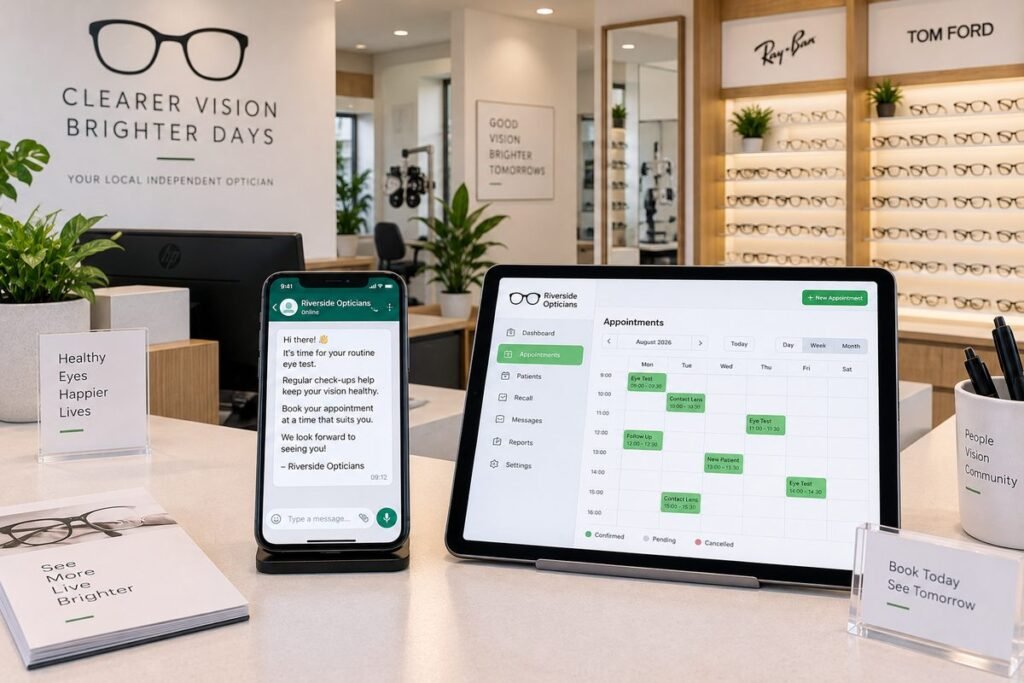
If your optician practice is losing patients to missed recalls, watching contact lens customers drift to online retailers or missing calls after 5pm — AI automation for optician practices is one of the most direct ways to recover that revenue in 2026. The UK optical market is worth £5.8 billion. Nevertheless, independent practices are losing ground to Specsavers and Vision Express every year. The difference is rarely clinical quality. Instead, it is operational systems. This guide answers every question an independent optician owner asks before committing to automation. Specifically, it covers recalls, no-shows, after-hours calls, contact lens reorders and exactly what it costs.
What You Will Find in This Guide
What This Guide Covers — AI Automation Optician Practice 2026
- Independent optician owners and practice managers exploring how AI automation optician practice tools could reduce their admin workload and recover lost revenue
- Optometrist-owners running a single-branch or two-branch practice using Optisoft, Optinet or similar UK practice management software
- Dispensing optician practices wanting to stop contact lens customers buying online instead of reordering through the practice
- Mixed NHS and private practices across UK, UAE, Australia and Canada looking to automate recall, reminders and patient follow-up
Why Independent Opticians Lose More Revenue Than They Realise
Most independent optician owners know roughly what their DNA rate is. What they rarely calculate is what that number costs across a full year. AI automation optician practice research from Raven Vision — a UK-focused practice management company — found that a modest independent practice running 5,000 eye tests per year at a 10 percent no-show rate is leaving over £60,000 in revenue on the table annually. That figure does not include the downstream optical dispense that follows a completed eye test — typically the highest-margin transaction in the practice.
The Three Root Causes of Lost Optician Revenue
In our experience working with independent optical practices, lost revenue traces back to three specific problems. First, patients due for their annual eye test do not rebook unless the practice contacts them proactively. Without a systematic recall sequence, a significant share simply drift away or attend a chain competitor. Second, contact lens patients who run out of supply before their reorder reminder arrives buy from Vision Direct or Lenstore online. Once they establish that habit, they rarely return. Third, calls that arrive after 5pm or at weekends go to voicemail. Consequently, patients book elsewhere before the practice calls back the following morning.
Importantly, all three problems are directly addressed by AI automation. None require replacing clinical staff. Moreover, none require changing how examinations are conducted. They simply require building systems around the clinical work that prevent revenue from leaking out of the practice.
How AI Automation for Optician Practices Reduces No-Shows
The most impactful single automation for any AI automation optician practice system is the appointment reminder sequence. Research published in the Journal of Telemedicine and Telecare — a systematic review of 29 studies — found that automated reminders reduce missed appointments by approximately 29 percent on average. An ophthalmology-specific study in BMC Ophthalmology found a 38 percent reduction from SMS reminders alone. One independent practice in the East Midlands reduced its no-show rate by 31 percent after implementing automated confirmation and 48-hour reminder sequences.
Why Optician Appointment Reminders Need Specific Configuration
Optician reminders require more thought than most healthcare appointment types. Dilation appointments cause a specific pattern of same-day cancellations — patients arrive and realise they did not arrange a driver or cannot return to work with blurred vision. A reminder that includes specific dilation preparation information, sent 48 hours before the appointment, prevents the majority of these cancellations. Similarly, contact lens fitting follow-up appointments at one week and one month are frequently skipped by patients who feel their lenses are comfortable. A targeted reminder explaining why the follow-up matters clinically — not just a generic appointment reminder — significantly improves attendance at these appointments.
How AI Automation Optician Practice Systems Handle Annual Recall
Annual recall is the quiet engine behind the most profitable independent practices in 2026 — and the most neglected system in the majority of them. Without a proactive recall sequence, over 40 percent of patients skip their annual eye test and never rebook. Each lost patient represents years of compounding revenue from examinations, lenses and frames. Research from Jelo, an optometry practice software provider, found that a single-message recall converts 5 to 10 percent of lapsed patients. A well-structured five-touch recall sequence converts 25 to 45 percent.
How Recall Automation Works in Practice
We build recall workflows that trigger automatically based on each patient’s last examination date. The sequence starts 60 days before the patient is due, with an initial WhatsApp message noting their annual eye test is coming up. A second message follows at 30 days. A third at 14 days includes a direct booking link. A fourth at 7 days references any NHS or vision plan benefits that may be expiring — patients are significantly more likely to book when reminded that their benefits reset on a specific date. If the patient still has not booked, a final outbound call fires from the AI calling agent at day one before their due date.
Recall Segmentation by Patient Type
Furthermore, recall segmentation matters significantly. Healthy adults are recalled annually. Patients with diabetes, glaucoma or macular degeneration are recalled every six months. Contact lens wearers are recalled both for their annual examination and separately for their supply reorder. A well-configured n8n workflow applies the correct recall interval and message content to each patient cohort automatically.
Recovering Contact Lens Revenue With AI Automation Optician Practice Tools
Contact lens reorder revenue is one of the highest-ROI automation opportunities for any optician practice — and one of the most commonly lost. Each contact lens patient who establishes a habit of ordering online from Vision Direct or Lenstore represents approximately £200 to £500 in lost annual revenue from that patient alone. Across a practice with 200 regular contact lens patients, the cumulative loss is significant.
How Contact Lens Reorder Automation Works
We build reorder reminder workflows that track each contact lens patient’s supply cycle. The system calculates when a patient’s current supply is likely to run out based on their prescription, lens type and last order date. Approximately three weeks before supply depletion, a WhatsApp message reminds the patient their lenses are due for reorder and provides a direct link to call or message the practice. Additionally, patients who have not reordered within their expected window receive a follow-up message offering a quick telephone reorder or a contact lens check appointment.
The key insight here is timing. A reorder reminder sent after the patient has already run out of lenses and bought from an online retailer accomplishes nothing. Conversely, a well-timed message sent while the patient still has a two-to-three week supply converts reliably because the patient has no urgent reason to go elsewhere.
Handling After-Hours Calls and New Patient Enquiries
Traditional front desk operations miss 34 to 42 percent of incoming calls according to research on healthcare practice call handling — and a significant share of these missed calls represent new patient enquiries. An independent optician that misses a new patient call loses not just the first appointment but the lifetime value of that patient’s examinations, frames and contact lens reorders.
NHS vs Private Appointment Routing — How AI Handles This
One of the most common incoming queries at mixed NHS and private optician practices is whether the patient qualifies for an NHS-funded eye test. The eligibility criteria — age over 60, certain medical conditions, receipt of qualifying benefits, having a close relative with glaucoma — are fixed and well-defined. Consequently they are ideal for automation.
Automated NHS Eligibility Screening
We configure the website chatbot and calling agent to walk patients through NHS eligibility criteria before they book. A patient who qualifies for an NHS test is routed to the appropriate appointment type. A patient who does not qualify is given private pricing information and offered a private booking. This prevents the common scenario where a patient books an NHS appointment, arrives expecting a free test and discovers they are not eligible — causing frustration, wasted clinical time and a negative patient experience.
AI automation systems we deploy for optician practices handle administrative and booking queries only. Clinical eligibility decisions — including whether a patient qualifies for an NHS-funded sight test under GOS regulations — are confirmed by your clinical team at the point of examination. The automation screens and informs patients based on the published GOC and NHS eligibility criteria but does not make or record clinical determinations. We review this workflow with every practice before deployment to ensure alignment with your NHS contract obligations.
How AI Automation Gets More Google Reviews for Independent Opticians
Google reviews are the single most important factor in local search visibility for independent opticians competing against Specsavers and Vision Express. A practice with 80 reviews averaging 4.7 stars will consistently outperform a competitor with 15 reviews in local search results — regardless of clinical quality. The challenge is that asking patients for reviews manually is easy to forget in a busy practice environment, and chains have systematic processes that independent practices typically do not.
Automation closes this gap directly. Two hours after a patient collection — when a patient picks up their glasses — the system sends a WhatsApp message asking how they are getting on with their new eyewear. Patients who respond positively receive a direct link to your Google review page. Similarly, after a successful contact lens fitting or eye test, a review request fires automatically. We have seen independent practices go from 18 reviews to over 60 reviews within 90 days of deploying this system.
Complete n8n Workflow Blueprint — AI Automation for Optician Practices
n8n is the automation layer that connects your practice management software, WhatsApp reminders, calling agent and follow-up sequences. You can read more about how n8n compares to other automation platforms in our guide on n8n vs Zapier vs Make 2026.
Full Cost Breakdown — AI Automation Optician Practice 2026
One of the most common concerns we hear from independent optician owners is whether automation is affordable for a single-branch practice. The monthly running cost of a complete AI automation optician practice system is less than the revenue from two recovered eye test appointments per month.
Monthly Running Costs — Independent Optician Practice
Estimated ROI — What the Numbers Look Like
These figures are illustrative and based on results we have seen across healthcare and optical clients. Your specific numbers will depend on your current DNA rate, appointment volume, average dispense value and contact lens patient base. We model the numbers for your practice specifically during a free strategy call.
Does AI Automation Work With Optisoft or Optinet
This is the most common technical question we receive from UK independent opticians. Both Optisoft.NET and Optinet FLEX are the dominant practice management systems in UK independent optical practices. Neither offers a public-facing API in the same way that general healthcare platforms do.
Our Integration Approach for Optisoft and Optinet
We connect n8n to Optisoft and Optinet primarily through scheduled data exports. Both systems support CSV export of appointment data, patient recall lists and contact lens reorder schedules. n8n reads these exports on a scheduled basis — typically every 15 to 30 minutes — and triggers the appropriate WhatsApp or calling agent sequence based on what has changed. This approach is less real-time than a direct API connection but is robust, practical and sufficient for the vast majority of automation use cases. For practices on cloud-hosted Optisoft, we can also explore database-level integration where the hosting arrangement permits.
Optisoft and Optinet do not currently offer public REST APIs. The integration approach we use relies on scheduled data exports rather than live webhook connections. This means automation triggers have a 15 to 30-minute delay rather than firing in real time. For appointment reminders and recall sequences, this delay is operationally insignificant. For practices requiring real-time booking confirmation messages, we discuss the available options during the discovery call. We always review your specific software version and hosting arrangement before confirming the integration approach.
Implementation Guide — AI Automation for Optician Practices Step by Step
Most independent optician practices have the core AI automation optician practice systems fully live within 2 weeks. Here is the realistic implementation path.
- Review your practice management system — Optisoft, Optinet or other
- Set up scheduled data export from your PMS to n8n
- Configure WhatsApp Business API and connect to n8n
- Build appointment reminder sequences — including dilation-specific messaging
- Map recall intervals by patient type — annual, 6-monthly, contact lens
- Configure Retell AI with practice-specific script — NHS eligibility, pricing, brands, opening hours
- Build recall call script — personalised by patient name and last examination date
- Deploy Tidio chatbot on practice website with NHS vs private routing
- Build contact lens reorder reminder workflow with supply cycle tracking
- Run end-to-end test of all reminder and recall sequences
- Test NHS eligibility screening with sample patient queries
- Brief practice team on what the system handles and what still requires human input
- Run dummy appointment and recall cycle from booking through to collection follow-up
- System goes live — monitor first week of reminder response and confirmation rates
- Launch first recall campaign to patients overdue for their annual eye test
- Review call recordings from Retell AI — refine script based on real patient conversations
- Review DNA data and contact lens reorder retention at 30 days against pre-automation baseline
Can a Single-Branch Independent Optician Afford AI Automation
Yes — and single-branch independent practices are typically where the ROI is most immediate. Every recovered appointment and every retained contact lens reorder goes directly to the bottom line. A single-branch practice running 80 appointments per week at a 12 percent DNA rate is losing approximately 10 appointments per week to no-shows. Recovering half of those through automated reminders — five appointments per week at an average combined examination and dispense value of £180 — generates £900 per week in recovered revenue against a monthly automation cost of approximately £90.
Beyond revenue recovery, the time saving for a small practice team is substantial. Staff who currently spend two hours daily on recall calls, reminder calls and frame-ready notifications can redirect that time entirely to in-practice patient care. This is particularly significant for practices where the dispensing optician or optometrist is also handling front desk calls during quieter periods.
- Single-branch practices with high admin burden
- Practices with 10%+ DNA rates
- High contact lens patient volume
- Mixed NHS and private patient base
- Practices currently doing manual recall calls
- Optisoft/Optinet: no real-time API — 15-30 min delay
- Does not replace clinical dispensing judgment
- NHS eligibility screening is indicative only
- Contact lens supply tracking requires clean patient data
Is AI Automation Optician Practice Data Safe and GDPR Compliant
GDPR compliance for AI automation optician practice tools operates under standard UK GDPR. Patient contact data used for appointment reminders and recall sequences falls under the legitimate interests legal basis — the same basis used for existing NHS recall letters and appointment reminder texts that practices already send. Optical records are not clinical records in the same sense as GP or hospital records, which makes the data governance footprint more straightforward than many healthcare automation contexts.
Data Processing Agreements and GOC Obligations
Before deploying any system, we obtain Data Processing Agreements from all tool providers handling patient contact data. WhatsApp Business API, Retell AI and Tidio all provide DPAs as standard. We also review your practice’s privacy notice and GOC registration obligations to ensure they reflect the new processing activities. The automation system handles name, contact details, appointment type and product order data only — it does not access or process prescription or clinical examination data.
How Long Before an Optician Practice Sees Results
Appointment reminder systems show measurable changes in DNA rates within 2 to 4 weeks of deployment. The first full recall campaign — targeting patients overdue for their annual eye test — typically generates bookings within 48 hours of the first message wave going out. Contact lens reorder retention shows results within the first month as patients who would have bought online instead reorder through the practice.
Our Honest Assessment — AI Automation for Optician Practices in 2026
Independent opticians face structural pressure from well-resourced chains that will not ease. The gap in operational systems — recall discipline, reminder sequences, after-hours coverage — is where independent practices lose most ground. AI automation closes that gap at a monthly cost that represents a fraction of the revenue it recovers. Start with appointment reminders and one recall campaign. Prove the numbers in your own practice, then expand to contact lens reorder automation and the full workflow. The practices that ignore this will find it progressively harder to compete on patient volume as chains continue to invest in their own systems.
Frequently Asked Questions — AI Automation for Optician Practices
No-Shows, Recalls and Booking Systems
Contact Lens Revenue and Recall Automation
Costs, GDPR and Results Timeline
GDPR, NHS Routing and Results Timeline
NHS Eligibility and Results Timeline
Results Timeline
Book a free 30-minute call with our team. We will review your current DNA rate, recall system, contact lens patient volume and practice management software — and give you an honest view of what automation will achieve and what it will cost.
Book Free Strategy Call →growth@aiotagen.com | WhatsApp: +92 347 672 3746
Aiotagen builds AI automation systems for healthcare practices, real estate agencies, insurance brokers and professional services businesses across UK, UAE, Canada, Australia and Pakistan. 48+ systems deployed. GDPR compliant configurations available. aiotagen.com