AI automation for private hospitals is one of the most direct ways to recover lost revenue in 2026. The UK private healthcare market has reached $14.8 billion, driven by NHS waiting lists of 7.62 million patients. Moreover, private hospitals and independent clinics are experiencing unprecedented demand. Nevertheless, many are struggling to convert that demand into revenue efficiently — because their administrative systems have not kept pace with their clinical capacity. This guide covers every question a private hospital manager asks before implementing AI automation for private hospitals — from missed enquiries and no-shows to insurance pre-authorisation and consultant scheduling.
Why This Matters in 2026
What This Guide Covers — AI Automation Private Hospital 2026
- Private hospital managers and directors of operations exploring how AI automation private hospital tools could reduce admin costs and recover lost appointment revenue
- Independent clinic owners and consultant-led practices handling multi-specialist scheduling, insurance pre-authorisation and GP referral intake
- Private healthcare groups across UK, UAE, Australia and Canada looking to scale patient intake without proportionally scaling headcount
- Practice managers at specialist centres — orthopaedics, cardiology, oncology, women’s health — where appointment values and operational complexity are both high
How AI Automation Private Hospital Systems Reduce No-Shows
Each empty consultant slot in a private hospital costs approximately £200 to £500 in lost direct revenue — before accounting for the downstream diagnostic, pharmacy and follow-up revenue that a completed appointment generates. Furthermore, AI research published across healthcare scheduling platforms found that AI systems fill 95 percent of cancelled slots, compared to just 15 percent filled by front desk staff working manually. The difference is speed and availability — an AI system that detects a cancellation and immediately contacts the waiting list operates at any hour without delay.
The Multi-Step Reminder Sequence for Private Hospitals
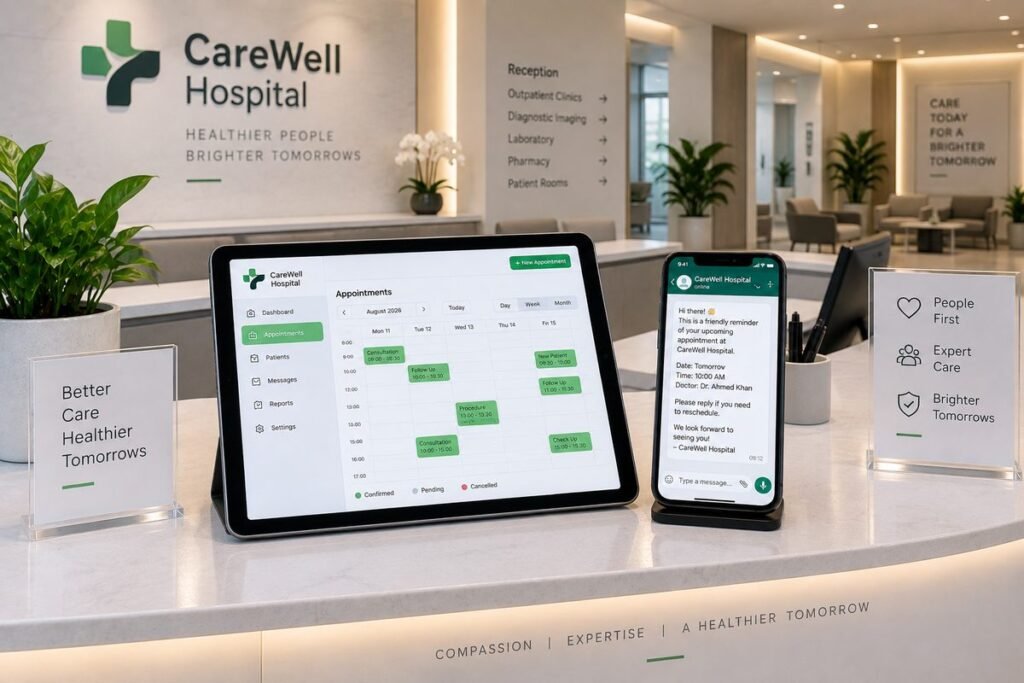
Private hospital appointments carry higher stakes than GP visits. Patients have typically waited weeks for their slot, paid a consultation fee or submitted an insurance claim, and arranged time off work. Therefore, a well-structured reminder sequence is essential. We build sequences that send a WhatsApp confirmation immediately after booking, a detailed 48-hour reminder including preparation instructions specific to the appointment type, and a same-day nudge. Moreover, if a patient does not confirm within four hours of the 48-hour reminder, an automated outbound call fires. For surgical pre-assessment appointments, the reminder also includes fasting instructions and pre-operative requirements — preventing same-day cancellations caused by patients arriving unprepared.
Capturing NHS Patients Switching to Private — AI Automation Private Hospital Lead Intake
The 7.62 million NHS waiting list patients represent the largest single source of private healthcare demand in 2026. Many of these patients are actively searching for private treatment options — often late in the evening or at weekends when NHS administrative teams are unavailable. A private hospital or independent clinic that answers their enquiry immediately, provides clear pricing information and offers to book a consultation within days converts a significantly higher proportion of these enquiries than one that relies on a callback the following morning.
24-Hour Enquiry Handling for Private Hospitals
We deploy a combination of AI calling agent and website chatbot that handles new patient enquiries around the clock. Specifically, when a prospective patient calls at 9pm after researching private orthopaedic surgery, the AI agent answers immediately, explains the consultation process, provides indicative self-pay pricing and offers to take their details for a booking call the following morning. Patients who visit the website at any hour receive equivalent service through the chatbot. Additionally, the system handles GP referral intake — collecting referral letter details, patient history and preferred consultant where relevant.
How AI Automation Handles Insurance Pre-Authorisation Queries
Insurance pre-authorisation is the single most time-consuming administrative process in private hospital management. Patients need to know whether their insurer covers the proposed treatment, what their excess is, and whether your hospital is on their insurer’s approved provider list. Each of these questions has a definitive answer that does not change week to week — making them ideal for automation.
Automated Insurance Screening and Pre-Authorisation Support
We configure the calling agent and website chatbot to handle the most common insurance queries — Bupa, AXA Health, Aviva, Vitality, WPA, Cigna and Allianz. When a patient asks whether their insurer covers a specific procedure, the system provides accurate information based on your current insurer panel. Furthermore, patients who need to initiate pre-authorisation are guided through the process step by step. The system collects their membership number, GP details and consultant recommendation and routes this to your medical secretary team in a structured format — significantly reducing the back-and-forth that currently consumes medical secretary time.
Research from Effra, a UK insurer billing automation platform, found that practices using billing and pre-authorisation automation cut the time from appointment to payment from 53 days to 13 days. This improvement directly impacts cash flow and reduces the administrative overhead of chasing outstanding claims.
AI automation systems we deploy for private hospitals handle administrative and booking queries only. Clinical pre-authorisation decisions — including medical necessity determinations — remain the responsibility of the treating consultant and the insurer’s clinical review team. The automation screens and informs patients based on your insurer panel and pricing schedule. It does not make or record clinical determinations. We review this workflow with your medical secretary and CQC compliance lead before deployment to ensure alignment with your regulatory obligations.
Filling Cancelled Slots Automatically — AI Automation Private Hospital Waitlist Management
Cancelled appointments in private hospitals are recoverable revenue — but only if the waiting list is contacted quickly enough. Research from Prosper AI found that AI-powered waitlist management fills 95 percent of cancelled slots, compared to just 15 percent filled manually. The reason is response time. A manual process involves a medical secretary identifying the cancellation, finding the waiting list, calling through it one by one and hoping someone is available. An AI system detects the cancellation instantly and contacts every patient on the waiting list simultaneously via WhatsApp, offering the slot on a first-come first-served basis.
How Waitlist Automation Works
When a patient cancels an appointment via WhatsApp confirm or cancel button, n8n immediately triggers a waitlist notification to patients waiting for that consultant or procedure type. The message explains that a slot has become available and includes a one-tap booking link. The first patient to respond secures the slot. Consequently, slots that would otherwise remain empty for days — or permanently — are refilled within minutes. Additionally, the system notifies your bookings team of the rebook in real time so the diary is updated immediately.
Post-Discharge Follow-Up and Patient Retention
Private hospitals compete on patient experience as much as clinical outcomes. A patient who receives a structured post-discharge follow-up — checking on their recovery, providing clear aftercare instructions and offering a follow-up appointment if needed — is significantly more likely to return for future treatments and to refer family and friends. However, post-discharge follow-up is consistently the first task cut when medical secretaries are under pressure.
Automated Post-Discharge Sequences
We build post-discharge workflows that trigger automatically when a patient is marked as discharged in your practice management system. The sequence sends a WhatsApp message 24 hours after discharge checking on the patient’s recovery. Specifically, it asks targeted questions relevant to the procedure type — pain levels, wound healing, medication adherence and mobility. Patients who indicate concern or difficulty are flagged to the clinical team immediately. Patients who indicate they are recovering well receive a Google review request two days later. This approach consistently builds review volume for private hospitals, which typically have far fewer reviews than their NHS counterparts despite delivering superior patient experience.
Complete n8n Workflow Blueprint — AI Automation for Private Hospitals
n8n is the automation layer connecting your practice management system, WhatsApp communications, calling agent and follow-up sequences. You can read more about how n8n compares to other automation platforms in our guide on n8n vs Zapier vs Make 2026.
Full Cost Breakdown — AI Automation Private Hospital 2026
The monthly running cost of a complete AI automation private hospital system is typically recovered from the revenue of two to three refilled cancelled slots per month. For a private hospital or multi-consultant clinic, the ROI case is among the strongest of any business type we work with.
Monthly Running Costs — Private Hospital or Multi-Consultant Clinic
Estimated ROI — What the Numbers Look Like
These figures are illustrative and based on results we have seen across private healthcare clients. Your specific numbers will depend on your consultant mix, appointment volumes, average slot values and current no-show rate. We model the numbers for your hospital or clinic specifically during a free strategy call.
Implementation Guide — AI Automation for Private Hospitals Step by Step
Most private hospitals and multi-consultant clinics have the core AI automation private hospital systems fully live within 3 weeks. The additional week compared to smaller practices reflects the complexity of multi-consultant scheduling and insurer panel configuration.
- Map your current patient journey — from first enquiry through to discharge and follow-up
- Review your practice management system — Cliniko, Healthcode, or bespoke hospital PMS
- Configure WhatsApp Business API and connect to n8n
- Build appointment-type-specific reminder messages — surgical pre-assessment vs outpatient consultation vs diagnostic
- Map your insurer panel — Bupa, AXA, Aviva, Vitality, WPA, Cigna and self-pay pricing
- Configure Retell AI with consultant-specific scripts — specialties, pricing, pre-authorisation guidance
- Build after-hours enquiry intake and GP referral collection workflows
- Deploy Tidio chatbot on hospital website with insurer and self-pay routing
- Build waitlist notification workflow — instant slot refill on cancellation
- Run end-to-end test — new patient enquiry through to post-discharge follow-up
- Test emergency clinical routing — confirm all urgent scenarios reach clinical team without delay
- Brief medical secretaries and bookings team on what the system handles
- Test waitlist automation — simulate cancellation and confirm slot refill sequence fires correctly
- System goes live — monitor first week of reminder response rates and waitlist conversion
- Review Retell AI call recordings — refine consultant-specific scripts based on real patient conversations
- Review no-show data against pre-automation baseline at 30 days
- Expand post-discharge follow-up sequence based on initial patient response data
Is AI Automation Private Hospital Data Safe — CQC and UK GDPR
Data governance for private hospital AI automation operates under UK GDPR and is subject to CQC inspection requirements. Every system we deploy for private hospitals is configured with this regulatory context in mind. Patient contact data used for appointment reminders, post-discharge follow-up and recall sequences is processed under legitimate interests — the same legal basis used for existing appointment confirmation letters and discharge summary communications.
CQC Compliance and Data Processing Agreements
Before deploying any system, we obtain Data Processing Agreements from all tool providers handling patient contact data. WhatsApp Business API, Retell AI and Tidio all provide DPAs as standard. Furthermore, we review your hospital’s privacy notice and data protection policy to ensure they reflect the new processing activities. The automation system handles appointment, contact and communication data only — it does not access, process or transmit clinical records, investigation results or prescription data. For hospitals with an appointed Data Protection Officer, we provide full documentation of the data flows for their review before go-live.
AI automation systems deployed in private hospitals are administrative tools only. They do not support or influence clinical decision-making, triage or treatment planning. All clinical governance obligations — including safe handover, emergency escalation and clinical documentation — remain the responsibility of the registered clinical team. We strongly recommend involving your Caldicott Guardian, Data Protection Officer and CQC compliance lead in the review of any new automated patient communication system before deployment. We provide full documentation of data flows and system architecture to support this review.
How Long Before a Private Hospital Sees Results From AI Automation
After-hours enquiry capture shows results from day one. Calls and website enquiries that previously went unanswered are captured and responded to from the moment the system goes live. Appointment reminder sequences show measurable changes in no-show rates within 2 to 4 weeks. Waitlist automation shows immediate results — the first cancelled slot after go-live is the first test of the system, and practices consistently report filling slots within minutes rather than days.
Our Honest Assessment — AI Automation for Private Hospitals in 2026
Private hospitals in 2026 face a rare combination of surging demand and operational constraint. The 7.6 million NHS waiting list patients represent years of growth opportunity — but only for private providers who can convert enquiries efficiently, retain patients through superior follow-up and recover the revenue currently lost to no-shows and administrative friction. AI automation does not replace the clinical teams that deliver private healthcare. Rather, it removes the administrative layer that currently prevents those teams from operating at full capacity. The ROI case for private hospitals is among the clearest we see across any sector we work in.
Frequently Asked Questions — AI Automation for Private Hospitals
No-Shows, Enquiries and Waitlist Management
Insurance, Self-Pay and After-Hours Enquiries
Costs, CQC Compliance and Results Timeline
Results Timeline and Implementation
Practice Management Integration
Book a free 30-minute call with our team. We will review your consultant mix, appointment volumes, current no-show rate and practice management system — and give you an honest view of what automation will achieve and what it will cost for your specific hospital or clinic.
Book Free Strategy Call →growth@aiotagen.com | WhatsApp: +92 347 672 3746
Aiotagen builds AI automation systems for private hospitals, healthcare practices, real estate agencies, insurance brokers and professional services businesses across UK, UAE, Canada, Australia and Pakistan. 48+ systems deployed. CQC and GDPR compliant configurations available. aiotagen.com